Locked out: Cargill workers continue to protest in Fort Morgan

FORT MORGAN, Colo. — Cargill, a meatpacking giant and America’s largest private company, has locked out more than 1,700 workers from its Fort Morgan meatpacking plant after the workers’ labor union rejected the new collective bargaining agreement.
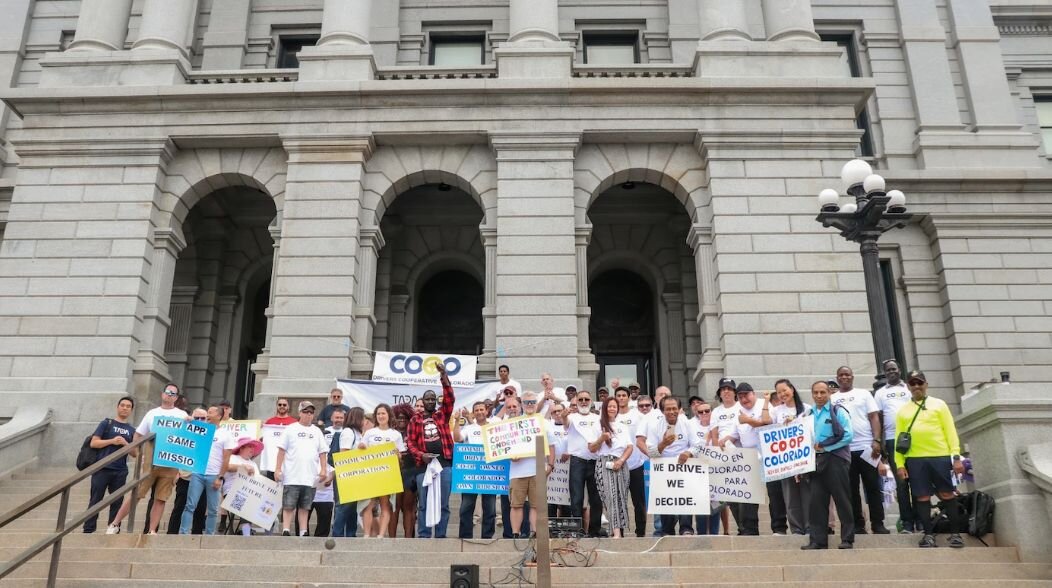
Every day from morning to dusk, hundreds of workers on rotating shifts protest the company’s labor lockout outside the meat processing plant, or nearby. On Thursday, they gathered at Glenn Miller Park holding signs that read, “The steaks are too high.”
“I’m scared. I’m a single mother,” said Seren Machuca, who has worked for Cargill for 15 years. “We don’t know how long this is going to go on.”
Machuca works as a bagger at the meatpacking facility, which can be rough on the body, she said. Her work involves nine or 10-hour days lifting 40 to 50 pound boxes, making sure machines are running correctly, helping coworkers and tracking orders.
“We struggled, but I stayed pretty loyal. I put so much time into the company. I don’t know, it’s kind of hard for me to change and start over,” Machuca said.
The lockout stems from ongoing contract negotiations between Cargill and workers represented by Teamsters Local 455 after their multi-year agreement expired on Feb. 22. The union has been pushing for higher pay and better health care coverage. A second round of bargaining took place on May 27, but the union rejected the company’s latest offer by an overwhelming 90% vote.
The employees never took a strike vote, but were told to stay home as negotiations continued. Cargill stopped paying workers May 19. Workers at the protest said the union will start paying them next week with $1,000 checks while they are locked out of Cargill.
“Before the lockout began on May 20, Cargill adjusted production schedules due to uncertainty around a potential work stoppage,” said Hli Yang, a spokesperson for Cargill. “While production was paused, Cargill continued paying employees.”
Some workers who handle meat said they have not been able to clock in at work for more than a month, since production stopped and cattle stopped arriving at the facility on April 23. Other employees, such as electricians and maintenance workers, have not been able to work since the lock out. Workers who were out of work longer were paid for 32 to 36 hours a week, which some said was less than their usual pay. Cargill stopped issuing paychecks last week.
Union workers will make $1,250 a week during the lockout, Chris Suazo, a Local 455 business agent, told The Colorado Sun. The money comes from the Local 455 and the International Brotherhood of Teamsters.
Elvia Valdez, who was born in Fort Morgan, started working at Cargill in 2000.
“In 2026, you see everything going up in price. It’s just really hard and what they want to give us is just not feasible,” Elvia Valdez said. “I’ve worked in packing, bagging, table-line meat processing, sharpening knives and cutting meat… and it’s a hard job. My mom worked there for 30 years and she’s already got arthritis all over her fingers.”
Valdez said she worked her way up to her current position as a leadman after 14 years on knife work, which she described as the hardest job and one that nearly made her quit. In her current role, she still watches for bones or products that are not supposed to be on the bone mess, and handles a range of tasks under her supervisor, she said.
“We will not have insurance anymore after the end of May… so in a couple days,” Valdez said. “I feel like s--t. I have a kid with a disability that needs to be seen in July and if this goes on until then, what are we going to do?”
Valdez said she has a 24-year-old son who is autistic, a 21-year-old son, and an 11-year-old daughter, all of whom are covered under her health insurance.
Many workers at the protest confirmed that they will be losing their health insurance through Cargill starting June 1, including Jessie Guerrero, who was born and raised in Fort Morgan and has worked for Cargill for more than a decade.
“I work in the bagging department. I have wear and tear on my knee from standing all day and pushing a lever and and bagging bigger calf pieces into bags all day,” Guerrero said. “I do enjoy the work, but I would like to have more appreciation because we bust our butts.”
Guerrero, a single mother of three children ages 14, 10 and 4, said she is worried about covering expenses for her kids, car insurance, cell phone bills and groceries. She said that when she stopped working about a month ago due to production halting at the plant, she was still paid, but at about half her usual amount. She said the checks have stopped coming in as of last week.
“I’m making it work for now through savings, doing what I can, and trying to find an extra part-time job, but no one is hiring,” Valdez said. “Since school is out, all the part-time jobs are being taken by high schoolers who are promising to come back for full-time work.”
She said the uncertainty is scary and that Cargill is a major part of the community, but believes the company needs to better appreciate its workers.
Cargill employs about 2,000 people at its Fort Morgan plant, which is more than 15% of the city’s population of 12,000 residents, making it a major driver of the local economy.
Hundreds of the workers are Somali refugees and migrants from Haiti, among other countries.
Yusef Ahmed of Somalia has been working at Cargill for nine years. He sends money back home to his wife and three children to provide for them.
Since he moved to Fort Morgan a decade ago, he has been able to visit his home country two times, he shared.
“Oh, it’s [a] problem,” he said of the lockout. “My home, my car, my gas, my family I have to pay in Africa… it’s [a] problem.”
Based on facts, either observed and verified firsthand by the reporter, or reported and verified from knowledgeable sources. To read more about why you can trust the journalism of Rocky Mountain PBS, please visit our editorial standards and practices page.